
CALL FOR PROJECTS 2026
STRUCTURAL COLLABORATIVE RESEARCH IN MILITARY MEDICINE (SCRiMM)
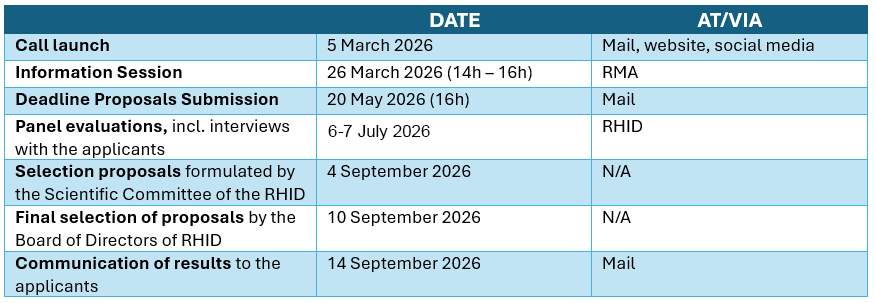
In line with Belgian Defence’s aim to reinforce the technological and knowledge base at national level, the Royal Higher Institute for Defence wishes to enhance research collaborations with the different universities and associated university hospitals in the field of military medicine. Therefore, an annual call for projects with dedicated themes will be launched. To inform potential applicants about the context, scope and modalities of this pilot call, a dedicated info moment will be organised on Thursday 26 March 2026, from 14.00 to 16.00 at the Royal Military Academy in Brussels.
TIMELINE
Theme 1 – Advancing Military-Relevant Research on (Mild) Traumatic Brain Injury (mTBI)
Background and Defence Relevance
Mild traumatic brain injury (mTBI) represents one of the most prevalent yet under-recognized health challenges in modern military operations, with blast exposure and blunt head trauma identified as major contributors in recent conflicts. Defence forces face a growing need to accurately detect, monitor, and manage mTBI sustained during training, deployment, or combat-related activities, including repeated low-level blast exposures and combined mechanisms of injury. Blast-related mTBI has been associated with persistent symptoms, cortical thinning, and subtle cognitive and executive dysfunction in service members and veterans, underlining its long-term impact on force readiness and health.
Despite increasing awareness and multiple NATO initiatives, significant capability gaps persist in rapid field assessment, early detection of subclinical injury, objective recovery monitoring, and personalized rehabilitation pathways. Addressing these gaps requires interdisciplinary research that bridges neuroscience, biomedical engineering, rehabilitation medicine, and defence technology, and that explicitly considers the unique operational context and cumulative exposure patterns of military personnel. This call seeks projects that respond to these unmet needs while maintaining a clear trajectory towards operational application.
Scope
This call invites 4-year PhD research proposals that aim to explore innovative, evidence-based, and dual-use solutions across the full continuum of mTBI care — from prevention to recovery. Projects may include, but are not limited to:
- Prevention & Risk Reduction, and workload management
- Detection & Monitoring
- Treatment, Rehabilitation & Return to Duty
- Recovery, Long-Term Outcomes & Readiness
Expected Outcomes
Projects funded under this theme should advance both scientific understanding and Defence capability in the domain of mTBI. Anticipated outcomes could include:
- Novel diagnostic, monitoring, or decision-support technologies operating at TRL 3–5 or higher with clear potential for further maturation in Defence settings.
- Evidence-based prevention, rehabilitation, and return-to-duty strategies, aligned with or extending existing military clinical practice and activity-progression guidelines.
- Strengthened cross-sector partnerships between academia, civilian healthcare systems, and Defence medical or research units, including potential integration with multinational NATO efforts. Participation to NATO scientific working groups (NATO STO) by representing Belgian Defence will be encouraged.
- Well-defined pathways for subsequent translational studies, implementation research, or integration into Defence policy, doctrine, and practice where appropriate.
- The scientific output will be compiled in a PhD thesis.
Theme 2 – Posttraumatic stress disorder (PTSD) Treatment
Background and Defence Relevance
Public safety personnel (PSP), including military personnel, police officers, firefighters, paramedics and veterans, are repeatedly exposed to potentially traumatic events such as violence, serious injury, or death in the line of duty. This sustained exposure contributes to a markedly elevated risk of developing posttraumatic stress disorder (PTSD) and related operational stress injuries. Despite the existence of well-validated trauma-focused psychotherapies, PSP often face organisational, cultural, and logistical barriers to accessing or completing standard outpatient treatments. As a result, untreated or chronic trauma related disorders continues to impact operational effectiveness, workforce retention, and overall well-being.
Intensive PTSD treatment models, condensing therapy sessions into a shorter time frame (e.g. 1–3 weeks), have gained traction internationally, particularly within military and veteran care systems. These approaches have shown improved treatment engagement, accelerated symptom reduction, and reduced dropout rates compared to traditional weekly models. However, evidence supporting such models for PSP populations remains sparse.
Importantly, the spectrum of operational and trauma-related mental health difficulties extends well beyond PTSD. Comorbid presentations—such as depression, anxiety, moral injury, or substance use—are frequently observed and have been well documented in the literature. Addressing this broader clinical reality calls for a transdiagnostic perspective, which targets shared psychological mechanisms across disorders rather than focusing narrowly on PTSD alone. Such an approach would represent a meaningful innovation, better aligned with the complexity of psychic distress observed among PSP.
This theme addresses a growing need to evaluate intensive treatment pathways for PSP in Belgium, aligning with both national mental health priorities and Defence-related efforts to support trauma-affected operational personnel. It brings together expertise from clinical psychology, psychiatry, occupational health, implementation science, and public safety organizations to generate actionable evidence for system-level improvement.
Scope
This call invites 4-year PhD research proposals focused on designing, implementing, and evaluating innovative, evidence-based models for intensive treatment adapted to PSP needs. Projects may include, but are not limited to:
- Feasibility and Acceptability
- Effectiveness and Outcomes
- Implementation Science and Adaptation
- Comparative Effectiveness and Cost-Benefit
- Digital and Hybrid Delivery Models
Expected Outcomes
Projects funded under this theme should strengthen both scientific knowledge and practical capacity to deliver effective are for Defence. Anticipated outcomes could include:
- Validated models of intensive outpatient treatment with established feasibility, acceptability, and preliminary effectiveness in e.g. Belgian PSP populations.
- Implementation and adaptation guidelines to inform best practices for trauma treatment delivery in high-stress occupational settings.
- Enhanced intersectoral collaboration between academia, Defence, emergency services, and public health authorities, including opportunities for participation in multinational or NATO-aligned mental health initiatives.
- Evidence-based recommendations for scaling up intensive programs or integrating them within existing PSP healthcare infrastructures.
- Completion of a PhD dissertation and scientific publications contributing to national and international PTSD research.
More detailed information on the themes and the call can be found in the 2026 Information Document.
For more information: scrimm@mil.be
Call Important documents
- Présentation (SCRiMM Infoday Call 2026) – 26 march 2026
- Information Document
- Full proposal template
- Gantt Chart
- Evaluation Matrix
- Contract – Annex II
- FAQs
Running Projects –
Templates to download
- Initial report [French] & [Dutch]
- Annual Report
- Final report
For more information: scrimm@mil.be
Archive: CALL FOR PROJECTS 2025