
As part of a series of publications by the Centre for Security and Defence Studies (CSDS) on armed groups in the eastern Democratic Republic of the Congo (DRC) and in the run-up to our next evening conference (‘Eastern Congo at a Crossroads: Conflict Dynamics, Regional Security and Armed Actors’, 15 September 2026), the Royal Higher Institute for Defence (RHID) is pleased to announce the publication of a new e-Note, focusing on the Congo River Alliance (Alliance fleuve Congo – AFC) and the March 23 Movement (M23).
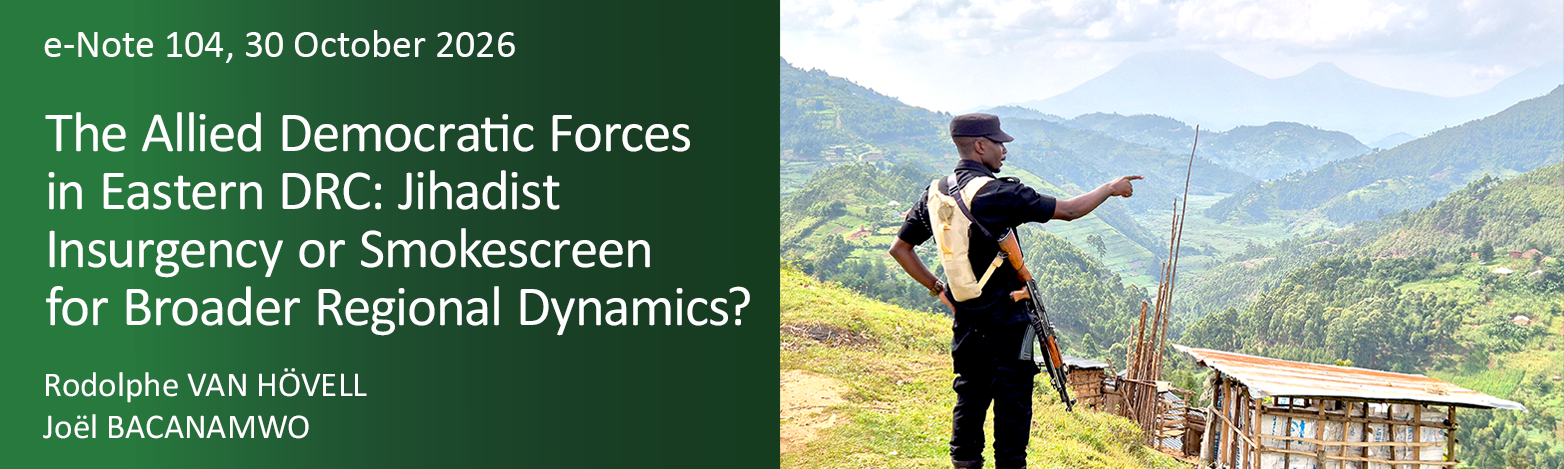
The Allied Democratic Forces (ADF), originally established in Uganda in 1995 and formally aligned with the Islamic State (IS) in 2019, are one of the most lethal armed groups operating in the Democratic Republic of the Congo (DRC). This e-Note examines the recent evolution of the ADF in the context of the March 23 Movement (M23)/Congo River Alliance (Alliance fleuve Congo – AFC) rebellion, the redeployment of Congolese security forces and the implementation of Operation Shujaa. It argues that the group’s territorial expansion and enduring resilience are not only the result of its military capabilities or ideological affiliation with IS but are also rooted in complex local and regional socioeconomic dynamics. While military operations have exerted pressure on the ADF, they have also contributed to shifts in its operational geography and patterns of violence. The analysis further highlights that counterterrorism approaches alone are insufficient to address the conditions that enable the group’s continued existence and adaptation.
Download e-Note 104Research lines: Sahel and Sub-Saharan Africa
Image source: © Rodolphe van Hövell (CSDS)
e-Note 104
The Allied Democratic Forces in Eastern DRC: Jihadist Insurgency or Smokescreen for Broader Regional Dynamics?
Rodolphe VAN HÖVELL
& Joël BACANAMWO