
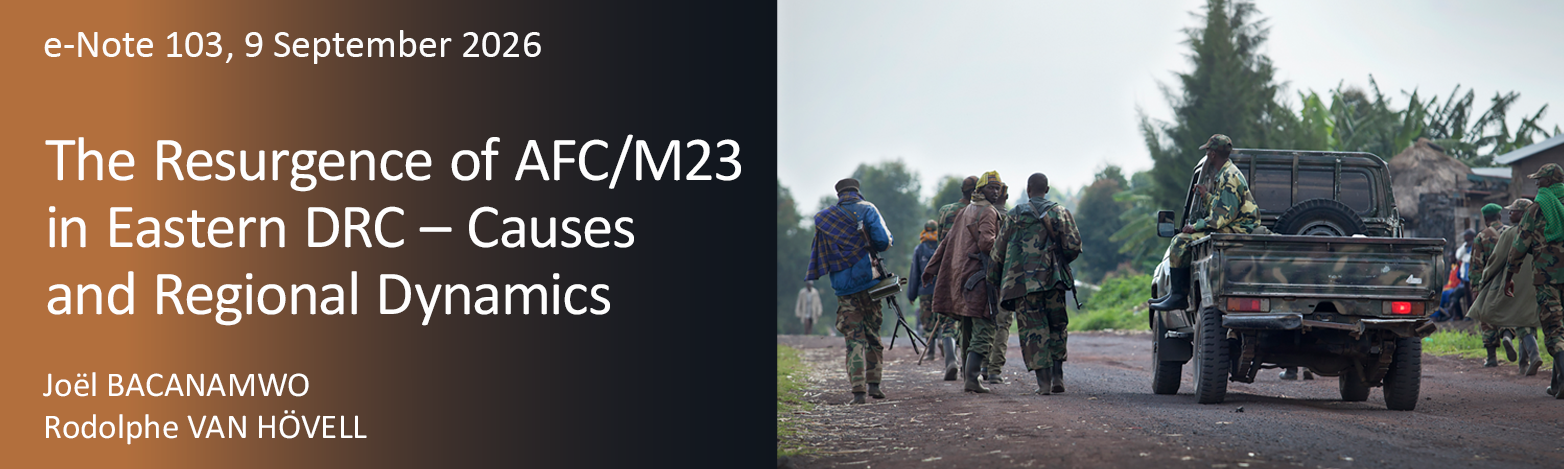
As part of a series of publications by the Centre for Security and Defence Studies (CSDS) on armed groups in the eastern Democratic Republic of the Congo (DRC) and in the run-up to our next evening conference (‘Eastern Congo at a Crossroads: Conflict Dynamics, Regional Security and Armed Actors’, 15 September 2026), the Royal Higher Institute for Defence (RHID) is pleased to announce the publication of a new e-Note, focusing on the Congo River Alliance (Alliance fleuve Congo – AFC) and the March 23 Movement (M23).
This e-Note examines the resurgence of AFC/M23 in the eastern DRC since 2021 and looks at some of the historical, political, regional and economic factors that have contributed to their return as a key driver of insecurity. It provides an overview of the origins of the conflict, including the aftermath of the 1994 Rwandan genocide, tensions concerning Rwandophone communities, previous peace agreements and weaknesses of the Congolese state. In addition, it considers the importance of natural resources such as coltan and gold, as well as regional trade and transit routes involving Rwanda, Uganda and Burundi. The e-Note argues that the conflict is influenced by several interconnected factors rather than by competition over mineral resources alone, including ethnic tensions, governance problems, regional interests and economic aspects.
Download e-Note 103Research lines: Sahel and Sub-Saharan Africa
Image source: © MONUSCO/Sylvain Liechti (CC-by-sa-2.0)

e-Note 103
The Resurgence of AFC/M23
in Eastern DRC
Causes and Regional Dynamics
Joël BACANAMWO & Rodolphe VAN HÖVELL