This e-Note examines the Islamic Republic of Iran’s (IRI) maritime grey-zone strategy and its implications for regional and international security. Focusing on the Strait of Hormuz, it analyses the 2026 crisis, during which the Islamic Revolutionary Guard Corps (IRGC) announced the strait’s closure without imposing a formal blockade. Through threats, limited attacks and coercive signalling, the IRI effectively disrupted shipping and energy flows by creating an “insurance-driven shutdown”. This episode demonstrates how maritime risk can be weaponised to produce significant economic and geopolitical effects without crossing the threshold of conventional warfare. The analysis argues that the crisis reflects the maturation of the IRI’s maritime grey-zone approach and highlights the growing importance of the maritime domain as a theatre of strategic competition. It also examines the IRI’s ambition to establish a maritime “new security belt” extending from the Persian Gulf to the Red Sea. The e-Note concludes that while enhanced maritime security, resilience measures and international coordination may mitigate immediate disruptions, they are unlikely to address the underlying sources of instability. As long as the current regime persists, it is likely to continue to rely on grey-zone coercion as a core instrument of statecraft, leaving critical maritime corridors vulnerable to strategic exploitation. Lasting regional stability will therefore require both sustained pressure on the IRI and a fundamental change in Iran’s political trajectory.
Download e-Note 102Research lines: Non-Arab Muslim World; Middle East and North Africa
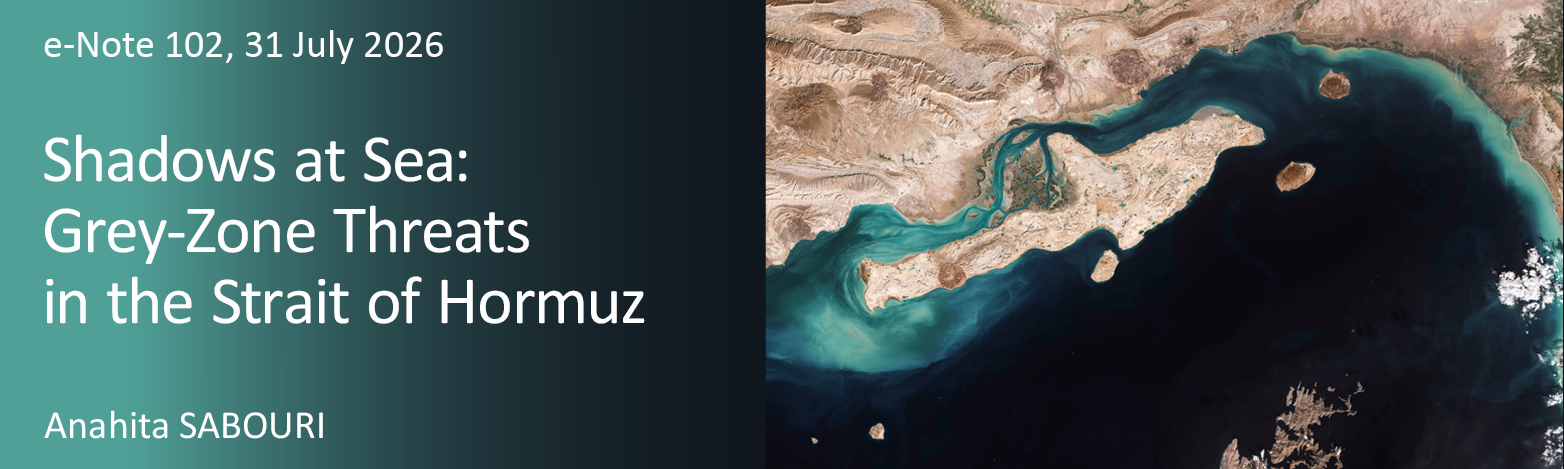
Image source: © European Space Agency (ESA) (CC BY-SA 3.0 IGO)