
Since the beginning of the war in Ukraine in 2022, the Baltic Sea Region (BSR) has experienced a growing number of critical undersea infrastructure (CUI) sabotage incidents. These continued even after Finland and Sweden joined NATO in 2023 and 2024 respectively, with further incidents recorded in late 2024 and beyond. National, sub-regional and international responses have steadily intensified over this period. Nationally, states are investing in hybrid threat countermeasures and deepening bilateral security ties. Internationally, new NATO and sub-regional structures have been established to protect critical infrastructure, while NATO’s Baltic Sentry operation, the European Union (EU)’s Action Plan on Cable Security and EU sanctions against the Russian shadow fleet stand out as operational highlights. Nevertheless, significant gaps remain in the resilience, deterrence and protection of CUI – particularly below the waterline. This Focus Paper analyses progress made, examines the evolving character of the hybrid threat and suggests further avenues for strengthening critical infrastructure security.
Download the Focus Paper 65Research lines: Europe; Threats, challenges and strategic responses; Eurasia
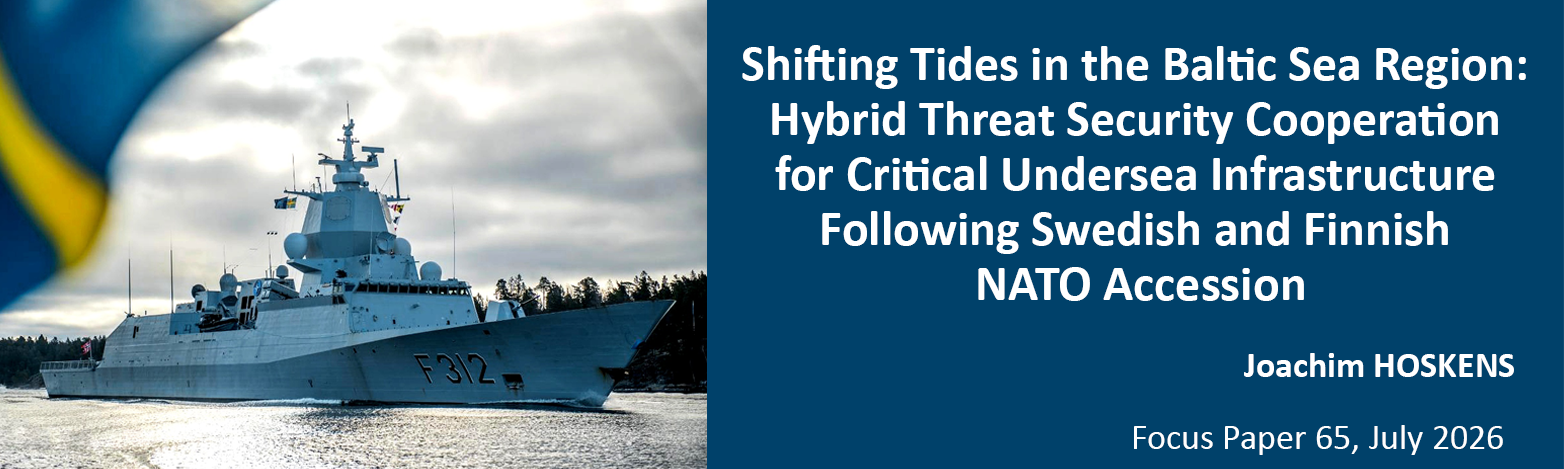
Source image : © NATO Allied Maritime Command

Focus Paper 65
Shifting Tides in the Baltic Sea Region: Hybrid Threat Security Cooperation for Critical Undersea Infrastructure Following Swedish and Finnish NATO Accession
Joachim HOSKENS
CSDS intern