
This Focus Paper analyses the evolution of Russia’s military space posture and its growing entanglement with nuclear deterrence, paying particular attention to lessons drawn from the war in Ukraine. It first examines how Russian doctrine increasingly treats outer space as an autonomous theatre of operations, central to information confrontation, strategic aerospace operations and long-range precision strike. It then assesses the organisation and limitations of Russia’s Space Forces and satellite inventory, highlighting structural weaknesses linked to sanctions, industrial decay and dependence on foreign microelectronics. The paper reviews Russia’s counterspace toolkit (electronic warfare, cyber operations, direct-ascent ASATs, directed-energy weapons and co-orbital inspector satellites), showing how Moscow has favoured non-kinetic, deniable measures while preserving ambiguous kinetic options for deterrence signalling. Finally, it explores how vulnerabilities in early warning and nuclear C3I, as exposed by the Ukraine war, have contributed to a doctrinal lowering of Russia’s nuclear threshold and are driving efforts to densify orbital infrastructure, integrate space and counterspace, as well as harden command systems. The conclusion draws up implications and lessons for Belgium, the EU and NATO, arguing that space resilience has become a core pillar of European deterrence and crisis stability.
Download the Focus Paper 60Research lines: Defence capabilities and technologies; Eurasia
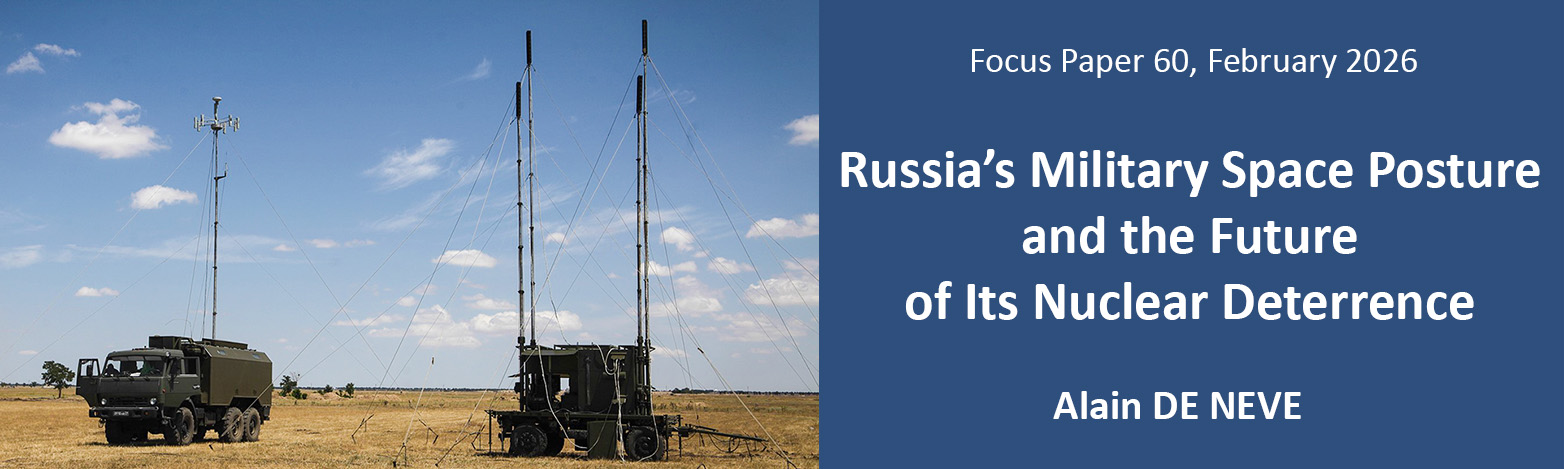
source image: http://мультимедиа.минобороны.рф/multimedia/photo/gallery. htm?id=59072@cmsPhotoGallery – Денис Абрамов (Denis Abramov)